





The Reason Your Heart Health Might Be Why You Can't Relax
|
|
Time to read 5 min
|
|
Time to read 5 min
Table of Contents
You meditate most mornings. You've tried the breathing exercises. Maybe you journal, maybe you've cut back on caffeine, maybe you've read every article about finding calm this month. And you still feel wired more often than not.
It's easy to read that as a personal failure, like you're just not doing mindfulness right. But a real piece of the puzzle has nothing to do with mindset at all. It has to do with your heart health, and specifically, how well your heart and your nervous system are communicating with each other.
Most people think of the brain as the one giving orders and the heart as the one following them. It actually runs both directions, and the heart sends more signals up to the brain than the brain sends down to it. This happens through the vagus nerve, a nerve that connects your brain to your heart, lungs, and digestive system and controls the shift between feeling wound up and feeling calm.
How well that shift happens shows up in something researchers can actually measure: heart rate variability, or the small natural changes in time between your heartbeats. A study following adults over a week of daily life found that people with higher resting heart rate variability reported less negative emotion and greater emotional well-being day to day. In other words, this isn't an abstract wellness concept. It's a measurable signal tied to your heart health, not something you can think your way into.

The relationship between your heart and your mood isn't one-directional, and it isn't occasional. A research review on the heart-brain axis describes this as a bidirectional relationship, where cardiovascular strain and emotional strain feed into each other over time rather than one simply causing the other.
Practically, that means the version of "can't relax" a lot of people experience isn't purely psychological. It can be a heart health issue showing up as an inability to unwind, regardless of how many calming apps you open.
Two ingredients commonly studied for heart health turn out to have research behind mood and energy too, separate from their cardiovascular benefits.
Omega-3 fatty acids, specifically EPA and DHA, are best known for supporting heart health, but the connection to your brain runs deeper than mood. A study covered by the American Heart Association found that in older adults with coronary artery disease, DHA and EPA supplementation improved cognitive function, including verbal fluency, memory, and processing speed. Separately, a 2025 meta-analysis of 58 studies found that omega-3 supplementation produced a significant improvement in attention at daily doses around 2,000 mg. The heart-brain connection, in other words, shows up in focus and clarity, not just in calm.
CoQ10 tells a similar story. It's a compound your body uses to produce cellular energy, and levels naturally decline with age. A meta-analysis of 13 randomized controlled trials found that CoQ10 supplementation reduced fatigue, particularly in people whose fatigue was tied to a fatigue-associated condition or naturally lower CoQ10 levels. It's a reasonable piece of a formula for supporting energy, not a guaranteed energy boost for everyone regardless of their starting point.
Here's what the research found for each:

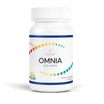
Most conversations about calm and happiness stay entirely in the realm of mindset. OMEGA⁺⁺⁺ approaches it from the other direction, supporting heart health and cellular energy, the physical side of the equation these habits alone can't reach.
August brings a stretch of overlapping reminders to slow down, from National Wellness Month to International Peace Month to Happiness Happens Month, and most of the advice attached to all three lives in the same place: breathe more, journal more, unplug more. None of that is wrong, but it treats calm as purely a mental exercise.
If your heart health is part of what determines how easily your body can actually downshift, then supporting it directly is a piece most routines skip entirely. That's the gap OMEGA⁺⁺⁺ is built to fill.*
The vagus nerve connects your heart and brain in both directions, and it governs the shift between feeling wound up and feeling calm.*
Heart rate variability, a measure of heart health, is linked to better emotional regulation and faster recovery from stress in daily life.
Research on omega-3 fatty acids has found improvements in attention and cognitive function, including in adults with heart disease, separate from their cardiovascular benefits.*
CoQ10 has been shown to reduce fatigue in clinical trials, particularly in people with lower baseline levels.*
OMEGA⁺⁺⁺ supports circulation and cellular energy through omega-3, omega-9, CoQ10, vitamin K2, borage oil, and Fertilized Avian Egg Extract.*
Not exactly. The research points to a real connection between heart health and brain function, including attention and cognitive clarity, but it doesn't mean everyone who struggles to focus has a heart problem. This is general wellness information, not a diagnosis or treatment claim.
Most of the research behind these ingredients reflects consistent use over weeks to months, not an immediate effect. OMEGA⁺⁺⁺ is designed to support the physical foundation for calm and energy over time, alongside the habits you're already building.*
Yes. OMEGA⁺⁺⁺ supports the physical side of the equation, circulation and cellular energy, rather than replacing mental wellness practices. It works best alongside them, not instead of them.
Most fish oil products contain only omega-3s. OMEGA⁺⁺⁺ combines omega-3 and omega-9 fatty acids with borage oil for omega-6, giving you the full 3-6-9 profile plus joint comfort support, along with CoQ10 Extended Release, vitamin K2, and a proprietary Fertilized Avian Egg Extract for broader heart health support.*
LifePharm, Inc.
Our purpose is to offer healthy living and sustainable income for everyone.

MADE IN
U.S.A.

60-DAY MONEY BACK GUARANTEE

MADE IN A FDA REGISTERED FACILITY

CLINICALLY
STUDIED
CURRENT GOOD
MANUFACTURING
PRACTICE

CLEAN LABEL
CERTIFIED
MADE IN
U.S.A.
60-DAY MONEY BACK GUARANTEE
MADE IN A FDA REGISTERED FACILITY
CLINICALLY
STUDIED
CURRENT GOOD
MANUFACTURING
PRACTICE
CLEAN LABEL
CERTIFIED


